Porcelain Benchtops Central Coast, Cut to Your Kitchen
Since 1 July 2024 the manufacture, supply and installation of engineered stone benchtops has been prohibited nationwide under the Work Health and Safety laws, brought in after the silicosis crisis among stonemasons. Central Coast Custom Cabinets is fully compliant: we do not fabricate or install engineered stone. What replaces it is porcelain, natural granite and marble cut by licensed stonemasons, laminate or solid timber. Every one of those is cut to your kitchen rather than bought to a standard size. The benchtop is templated after the cabinetry is installed and levelled, not off a drawing, so the slab follows the room as built: the actual wall line, the real corner angles and the exact cut-outs for your sink, tap and cooktop. On a settled Central Coast home that difference is the job, because almost nothing in an older house is square. Fully insured to $20 million public liability, 12 years on the coast. For a free kitchen design consultation and a compliant benchtop recommendation, call 0485 032 128.
GET A FREE QUOTE
Central Coast Custom Cabinets
Porcelain benchtops Central Coast: compliant surfaces after the engineered stone ban
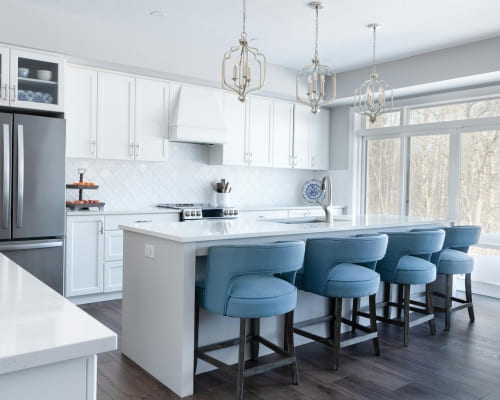
Porcelain benchtops on the Central Coast are what most kitchens land on once engineered stone is off the table. From 1 July 2024 it has been unlawful across Australia to manufacture, supply, process or install engineered (reconstituted) stone benchtops, panels and slabs, a Safe Work Australia prohibition brought in after fabricating the high-silica product caused an epidemic of silicosis in stonemasons. We do not touch the material. What replaces it is a short list of compliant surfaces, and the right one depends on budget, look and how the kitchen gets used. Porcelain is a fired ceramic slab, large format, heat and scratch resistant and effectively non-porous. Natural granite and marble are genuine quarried stone, each slab unique, cut and installed by the licensed stonemasons we partner with. Laminate remains the value option, with a colour and texture range that now includes convincing stone prints. Solid timber suits Hamptons and coastal kitchens and sands back over the years. Those four cover almost every brief we quote. The benchtop is specified alongside the cabinetry rather than after it, because the substrate, the cut-outs and the support all have to be built for the slab that is going on top, and we coordinate the stonemason so it is one job rather than three suppliers to chase.
Central Coast Custom Cabinets
Kitchen benchtops Central Coast: how each material handles humidity, salt air and sun
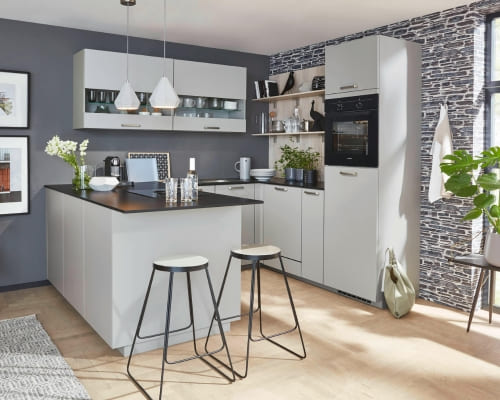
Gosford runs about 1,333mm of rain a year with humidity peaking near 62 per cent in February (source: Bureau of Meteorology, Gosford AWS), and a benchtop near the water gets salt on top of that. The materials behave differently. Porcelain is the least troubled: non-porous, so humidity does not reach it, UV stable so it will not shift colour on an alfresco servery, and unaffected by salt. Granite is dense but still porous, so it takes a penetrating sealer, and on a coastal kitchen we reseal on a shorter cycle than an inland one because salt and moisture work at the surface. Marble is softer and more porous again, etches on citrus and vinegar, and is the one material we will talk a client out of for a hard-working coastal kitchen unless the look is non-negotiable. Laminate copes well with humidity across the face but fails at the edges, so the vulnerable points are the sink cut-out and any unsealed join, which is why every cut-out we make is sealed before the top goes down. Solid timber moves with the seasons and needs oiling, more often in a humid room. Underneath all of them the substrate matters as much as the slab: cabinetry in a coastal kitchen is built from moisture-resistant HMR board with heat-sealed edges, because a benchtop is only as stable as what it is sitting on.
Central Coast Custom Cabinets
Stone benchtops Central Coast: granite, marble and natural stone
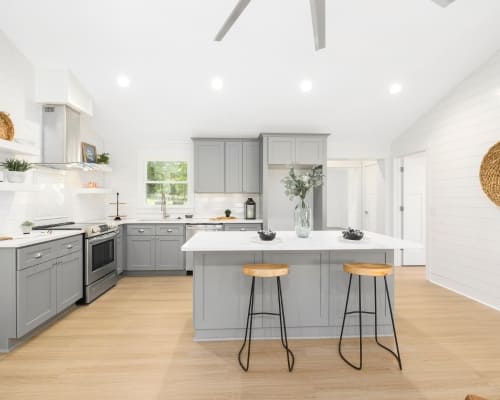
Granite benchtops are the other half of the post-ban market, and on the Central Coast they are still what people picture when they say stone benchtops. Granite is quarried rather than manufactured, so it carries no resin and sits outside the prohibition entirely. Every slab is different, which is the appeal and also the reason we send clients to the stone yard to choose the actual slab rather than a sample chip: movement, veining and colour vary across a single block. Marble is the softer, more dramatic alternative, better suited to a butler's pantry or a low-traffic island than a main run. Both are cut and installed by licensed stonemasons, which is a legal requirement rather than a preference, and we template the stone off the cabinetry once it is installed and level rather than off a drawing, so the slab matches the room as built. Thickness is usually 20mm or 30mm for natural stone, and a mitred return gives the heavy edge without the slab cost of a solid 40mm. Compared against porcelain, granite is warmer underfoot in appearance, takes a polished or honed finish, needs sealing where porcelain does not, and generally prices close enough that the decision comes down to look rather than money.
Central Coast Custom Cabinets
What a benchtop costs on the Central Coast, by material
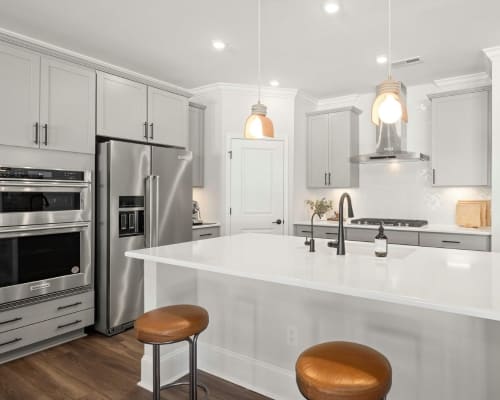
Benchtops are quoted by the square metre of slab plus fabrication, so these indicative ranges are per square metre supplied and installed, not fixed quotes. Laminate typically runs from around $300 to $600 per square metre, which is why it stays the value choice. Natural granite commonly lands between $700 and $1,300, with the spread driven by the slab itself, since a common granite and a rare one are not close in price. Porcelain sits in a similar band, roughly $900 to $1,500, and large-format slabs push the upper end because the sheet size that avoids a join also costs more to buy and to handle. Marble starts near granite and climbs well past porcelain for the sought-after stones. Solid timber falls between laminate and granite. On top of the slab, budget for fabrication and install: cut-outs for the sink, tap and cooktop, any mitred return to build a chunky edge, drainer grooves, and the splashback if it runs in the same material. A mitred 40mm edge on a 12mm porcelain slab, for example, costs more than the square metre rate implies because it consumes extra slab. Replacing a benchtop alone, on sound existing cabinets, is usually the cheapest way to change how a kitchen looks. Every top is priced after an on-site measure once the cabinetry is in, because the template has to match the room as built.
Central Coast Custom Cabinets
Laminate benchtops and benchtop replacement
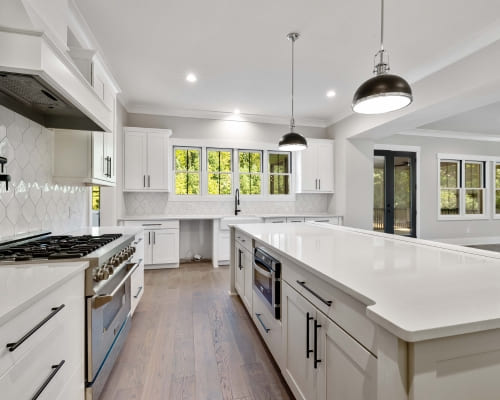
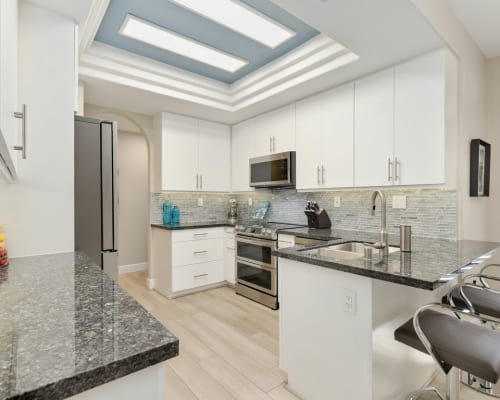
Not every kitchen needs a stone slab, and replacing a benchtop alone is one of the best-value jobs we do. Laminate benchtops have moved a long way: the current ranges print convincing stone and timber grains, finish in matt or textured surfaces that hide fingerprints, and cost a fraction of natural stone per metre. The trade-offs are real and worth stating plainly. Laminate will not take a hot pan straight off the cooktop, a deep scratch cannot be polished out the way it can in stone, and the edges are where failure starts, so a sealed sink cut-out and a properly finished join matter more than the colour choice. For a rental, a quick refresh before sale, or a family kitchen on a budget, it is the sensible surface. Benchtop replacement on its own suits a kitchen whose cabinets are sound but whose top is tired, dated or damaged. We measure the existing carcasses, check they are square and level enough to carry a new top, and replace the benchtop and sink without rebuilding the kitchen. Where the cabinets are failing as well, replacing the top alone is money spent twice, and we will say so at the measure. A full kitchen rebuild is covered on the custom kitchens page.
Central Coast Custom Cabinets
Porcelain and sintered stone benchtops, from slab selection to support
Porcelain is the surface most people land on once they learn engineered stone is off the table, and it is worth understanding why it is still allowed. A porcelain slab is a fired ceramic body, not crushed quartz bound together with resin.
Why porcelain is still permitted
The prohibition names porcelain products and resin-free sintered stone among its exclusions, so the real test on any slab you are shown is whether the supplier will confirm in writing that it contains no resin (source: Safe Work Australia, engineered stone prohibition). That does not make it dust-free. Since 1 September 2024 porcelain and ceramic products have sat inside the crystalline silica substances regulations, which means high-risk cutting must run with water suppression and extraction under a silica risk control plan (source: Work Health and Safety Amendment (Crystalline Silica Substances) Regulation 2024, NSW). We only put porcelain through licensed stonemasons who work that way.
Sintered stone and how it differs from porcelain
Sintered stone is the other resin-free slab on the market and it gets confused with porcelain constantly, partly because the two are often sold from the same rack. Both are fired mineral slabs with no resin binder, which is why both sit outside the engineered stone prohibition. The difference is the recipe and the press: a porcelain slab is a clay-based ceramic body, while sintered stone is natural mineral powder compacted under very high pressure and then fired, which is where the name comes from. In practice they behave similarly on a bench, non-porous, heat tolerant and no sealing schedule, and sintered stone is usually the denser and more impact-tolerant of the two. Both are still crystalline silica products once cut, so both fall under the September 2024 silica regulations and both go through the same licensed stonemasons working with water suppression and extraction. The practical test when you are shown a slab is the same either way: ask the supplier to confirm in writing that it contains no resin.
Slab format, thickness and edges
Slabs come large, commonly 3,200 by 1,600mm, and the format is the reason porcelain earns its place on a long island. A run that would carry a visible join in a smaller material can often be taken from a single slab. Twelve millimetres is the standard benchtop thickness. Twenty gives a heavier look without a mitre, while 6mm belongs on a splashback or a vertical face rather than a bench. If you want the chunky 40 or 60mm edge, that is a mitred return glued off a 12mm slab, and the mitre is the vulnerable line. Ask for through-body porcelain, where the pattern runs the full depth, because a chip in a surface-printed slab exposes a pale body underneath.
Upkeep, heat and outdoor use
What porcelain buys you here is low upkeep and outdoor tolerance. It is effectively non-porous, so unlike the natural granite and marble we also fit, it needs no sealing schedule, which is the same reason we use it on the bathroom vanity tops we build. That is the argument that usually wins in Erina, median age 61 and 65.7 per cent owner-occupied, where a forever kitchen is meant to look after itself. It is UV stable and heat tolerant as well, so it is what we specify for the alfresco kitchens and outdoor servery benches we build as custom joinery in Terrigal and Bateau Bay, where a resin-bound surface would chalk and shift colour in the open.
Access and substrate support
The constraints are handling and support. A slab that size is brittle in transit and unforgiving once cut, so we measure the access path before specifying a single-slab island. That means the stair-and-landing runs on the steep waterfront blocks off The Esplanade at Terrigal, the lift car and the turn out of it in the Gosford CBD towers on Mann Street, and the narrow side access on the old cottage lots along The Entrance Road at Long Jetty, where the retro strip is being renovated house by house. Support matters just as much, because 12mm porcelain wants a continuous, level, supported perimeter. We square the carcasses in the kitchen cabinetry we build and run subtop rails across dishwasher and appliance gaps and under any overhang, rather than trusting the slab to bridge them. Newer square slabs at Kariong and the estates ringing Tuggerah make that straightforward. It is far more work on a fibro cottage at Umina Beach, subdivided from 1914, or a post-war weatherboard in East Gosford. On those floors and walls nothing is quite true, and a mitred return will telegraph any twist left in the cabinetry. (Suburb figures: ABS 2021 Census.) Call 0485 032 128 to talk through a porcelain benchtop for your kitchen.
Central Coast Custom Cabinets is fully insured and just a call away on +61485032128 for a free quote.What Our Kitchen & Stone Benchtops Customers Say About Us
3 Step Process For Your Kitchen & Stone Benchtops Needs

Free Measure and Quote
We come to your home anywhere on the Central Coast, measure the real space, and talk through what you want. Seeing the actual room, including how square or settled the walls are, lets us give an accurate written quote rather than a guess. No cost, no obligation. Call 0485 032 128 to book.

Design and Material Selection
We finalise the layout and help you choose door finishes, benchtop material and hardware from our compliant range. This is where we flag the practical points for your home: HMR board in wet areas, corrosion-resistant hardware if you are near the beach, and honest guidance on materials like timber tops that need upkeep.

Build and Install
Your cabinetry is built square in our Gosford workshop, then delivered and installed by the same crew. We scribe the ends to your walls, pack everything level so reveals sit within about 2mm, and adjust every door and drawer before we leave. One accountable maker from first measure to the final adjustment.
Kitchen & Stone Benchtops In Central Coast
FREQUENTLY ASKED QUESTIONS
Everything you need to know about our Kitchen & Stone Benchtops In Central Coast
Do you install engineered stone benchtops?
No. Under the national Work Health and Safety prohibition that took effect on 1 July 2024, we do not fabricate or install engineered (reconstituted) stone. We build your kitchen with compliant surfaces instead, laminate, natural granite or marble, porcelain or solid timber.
What benchtop should I choose instead of engineered stone?
It depends on your budget and look. Laminate is the most economical and comes in a huge range; natural granite and marble give genuine stone through licensed stonemasons; porcelain is a hard, heat-resistant large-format option; and solid timber suits a coastal or Hamptons kitchen. We recommend based on your kitchen and budget.
Do you build the whole kitchen or just the cabinets?
The whole kitchen. We design and build the cabinets, doors, drawers and splashback, and coordinate the benchtop, including licensed stonemason fabrication for granite or marble, so it is one design and one install.
Who does the stone benchtop fabrication?
Natural granite and marble are cut and installed by licensed stonemasons we partner with, done safely and legally to a template that matches the cabinetry we built. We manage that coordination so you deal with one team.
How long does a new kitchen take?
A full custom kitchen typically takes around four to eight weeks from final design to install, depending on the door finish and benchtop. Two-pac doors and stone benchtops sit at the longer end. We confirm the timeline at quote.
Do you do kitchens across the whole Central Coast?
Yes. We design and install kitchens across the whole Central Coast, from Gosford and East Gosford to Terrigal, Woy Woy, Wyong, The Entrance and the Warnervale growth corridor.
Request A Free Kitchen & Stone Benchtops Quote
GET A FREE QUOTE
BUSINESS
SERVICES
OPERATING HOURS
Sun: 7:00am - 9:00pm
Mon: 7:00am - 9:00pm
Tue: 7:00am - 9:00pm
Wed: 7:00am - 9:00pm
Thu: 7:00am - 9:00pm
Fri: 7:00am - 9:00pm
Sat: 7:00am - 9:00pm